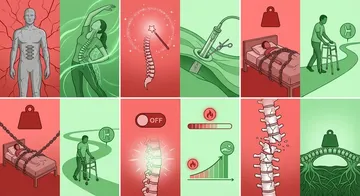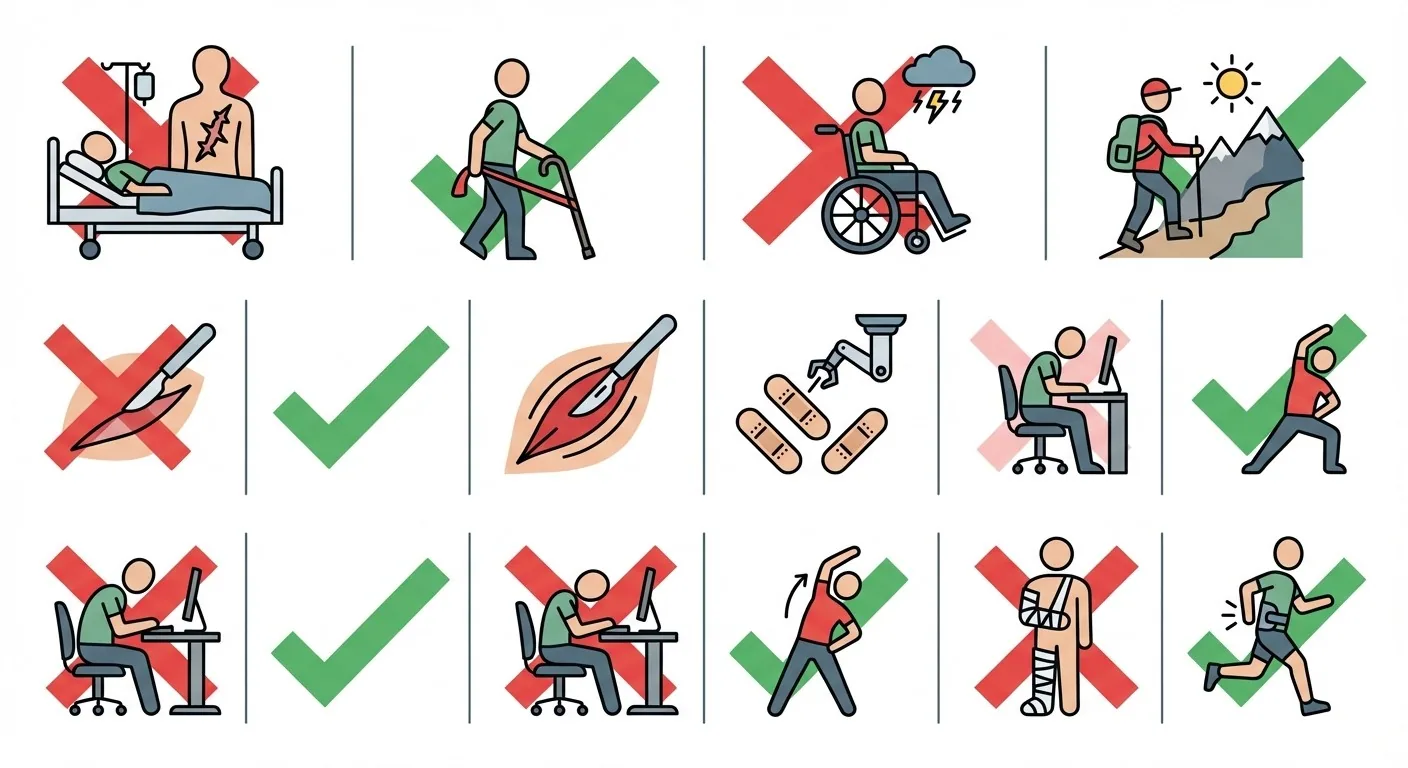
Myth 1: "You will be paralysed after lumbar herniated disc surgery"
Fact: This is the most common and most harmful myth. Lumbar herniated disc surgery (microdiscectomy) is not performed on the spinal cord, but on the nerve roots. In the lumbar region, the spinal cord ends at the L1-L2 level; herniated disc surgeries are usually performed at the L4-L5 or L5-S1 level. On the contrary, if surgery is not performed for a severe herniation, there is a risk of permanent nerve damage.

Myth 2: "If hardware is placed for a lumbar herniated disc, movement will be restricted for life"
Fact: The screw-rod (stabilisation) system is used to support the spine in cases of instability or slippage. Even with multi-level fusion, the vast majority of patients have a satisfactory range of motion.
Myth 3: "Everyone with a lumbar herniated disc needs surgery"
Fact: Conservative treatment (painkillers, physical therapy, epidural injections, lifestyle changes) is the first-line treatment. Surgery is indicated for severe pain that persists despite conservative treatment lasting longer than 6-8 weeks, progressive muscle weakness, or loss of bladder/bowel control.1,2 "Having a herniation on an MRI" alone is not a reason for surgery.
Surgery is indicated for severe pain that persists despite conservative treatment lasting longer than 6-8 weeks, progressive muscle weakness, or loss of bladder/bowel control.
Myth 4: "Cervical herniated disc surgery is very risky and can result in spinal cord paralysis"
Fact: Anterior cervical discectomy and fusion (ACDF) surgery is one of the safest surgeries in neurosurgery. The procedure is performed from the front (the front of the neck), and the spinal cord is not directly visualised or manipulated. The surgery usually takes 1-2 hours and the patient can be discharged the next day.
Myth 5: "I will never be able to return to work after surgery"
Fact: After lumbar herniated disc surgery, patients can return to work within an average of 78 days; however, those working in higher professional positions return to work faster.3 Key point: surgery performed at the right time and with the right indication increases working capacity, rather than restricting it.
→ Next page: S56 — Spine Surgery Myths (6-10)

Kaynaklar
- Kögl N et al. Dtsch Arztebl Int. 2024. PMID 38835174
- Yoon WW et al. EFORT Open Rev. 2021. PMID 34267943
- Laasik R et al. Acta Orthop. 2021. PMID 34269643
Doç. Dr. Özgür Akşan
Beyin ve Sinir Cerrahisi Uzmanı
Beyin ve Sinir · Sorumlu Yazı İşleri Müdürü ve Editör · Künye