Surgery should be considered in cases of cubital tunnel syndrome that do not respond to conservative treatment, clinical nerve dysfunction (progressive muscle atrophy or weakness), or if an abnormality is detected on EMG.1
Surgical Options
Simple Decompression (In Situ)
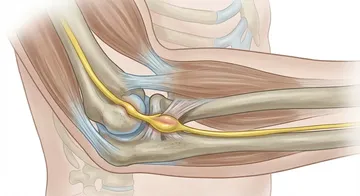
The roof of the cubital tunnel (Osborne's ligament) is cut, and the nerve is left in place. It is the least invasive surgical method. It is preferred if there is no nerve subluxation.
Full recovery cannot be guaranteed in patients who have developed muscle atrophy — early surgery is important.2,3
Anterior Transposition
The nerve is removed from behind the medial epicondyle and moved to the front. Three variants:
Subcutaneous transposition: The nerve is placed in the subcutaneous fat tissue. Subcutaneous transposition is a widely used, simple, and effective method.4,5
Intramuscular transposition: The nerve is placed within the flexor-pronator muscle group. It provides moderate protection.
Submuscular transposition: The nerve is placed under the flexor muscle origin.
Medial Epicondylectomy
The medial epicondyle is partially removed to relieve the pressure on the nerve. The nerve remains in its anatomical position. Advantage: the blood supply to the nerve is not disrupted.6
After Surgery
Simple decompression: a splint is usually not needed, and movement is started the next day to prevent adhesions. Transposition: a splint for 2-3 weeks, gradual movement. Full recovery cannot be guaranteed in patients who have developed muscle atrophy — early surgery is important.
→ Next page: S45 — Peripheral Nerve Injuries

Kaynaklar
- Folberg CR et al. Orthop Rev. 1994. PMID 8022643
- Mowlavi A et al. Plast Reconstr Surg. 2000. PMID 10946931
- Tong JS et al. Neural Regen Res. 2019. PMID 30539822
- Jaddue DA et al. Open Orthop J. 2009. PMID 19746170
- Liu CH et al. Medicine (Baltimore). 2015. PMID 26200640
- Popa M et al. J Hand Surg Br. 2004. PMID 15542216

Doç. Dr. Özgür Akşan
Beyin ve Sinir Cerrahisi Uzmanı
Beyin ve Sinir · Sorumlu Yazı İşleri Müdürü ve Editör · Künye